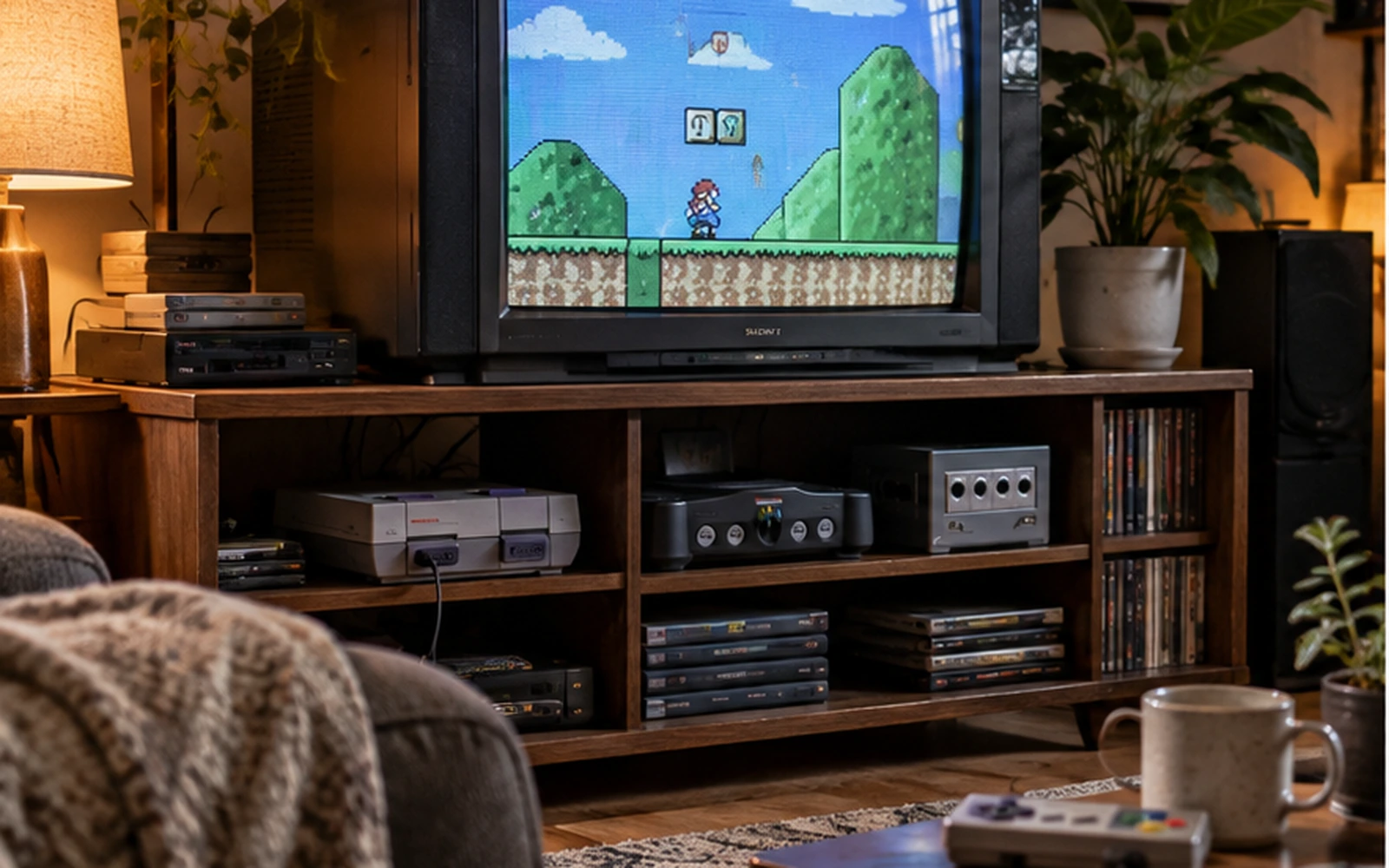
A good retro gaming setup is less about owning every old console and more about removing friction between you and the games. Start with the systems you genuinely care about, choose one display strategy, and make the wiring simple enough that you will actually use it.
Start with the games, not the hardware
Write down ten games you want to play most. That list usually tells you which machines matter and whether you need original hardware at all. If most of your favourites are available through accurate modern re-releases, a current console or PC may be the most convenient route. If you care about light-gun games, original accessories or exact controller feel, original hardware becomes much more important.
CRT vs modern television
A CRT gives older 240p and 480i games the look they were designed around, with excellent motion clarity and effectively no display-processing delay. The trade-off is size, weight and maintenance. A modern flat panel is easier to live with, but old consoles generally need a quality scaler or line doubler to avoid a soft picture and extra latency.
For a mixed setup, a small CRT beside a modern TV is often the best compromise: original hardware on the CRT, newer consoles and upscaled systems on the main display.
Choose the cleanest signal your console supports
Composite video is authentic, but it is rarely the sharpest option. Depending on the console and region, S-Video, RGB or component can produce a dramatic improvement without changing how the games behave. Avoid ultra-cheap HDMI adapters that stretch the image or add visible lag.
Controllers matter more than resolution
The right controller is one of the biggest parts of the original experience. Clean used pads, replace worn membranes when necessary and keep one good example for each system. If you use emulation, map controls deliberately instead of accepting a generic layout for every platform.
Make switching systems easy
Label power supplies, keep cables short and use a quality switcher if several machines share one display. A setup that needs ten minutes of cable swapping will become decoration. A setup that powers on in thirty seconds gets played.
Storage and ventilation
Older consoles need airflow and dry storage. Do not stack heat-producing systems tightly, and keep cartridges, optical discs and controllers away from direct sunlight or damp rooms. Dust is easier to manage when every device has a fixed place.
Build slowly
One console with a great controller and ten games is a better starting point than a wall of untested hardware. Add pieces only when they solve a real problem or unlock games you want to play.